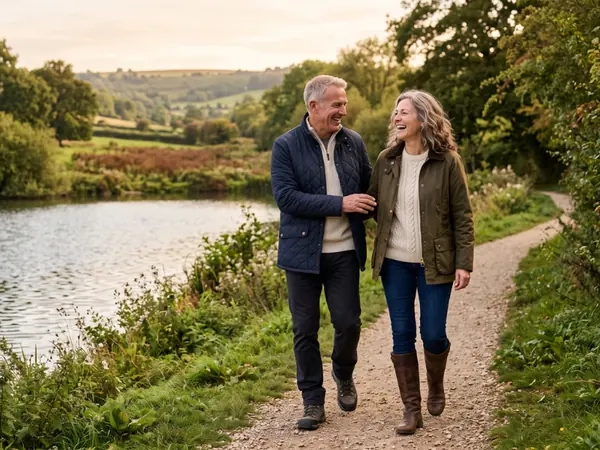
Living rurally does not shrink your chances. It changes the method.
The numbers look bad at first. Fewer people per square mile, fewer places to meet them, and a good chance you already know half of them. So most rural people conclude that dating is a city thing and give up on it quietly.
The thing working against you is not the population. It is the way most dating apps are built. They assume a dense town, a short search radius and a big pile of profiles to sort through. Drop that model into a valley in mid Wales and it returns eleven people, four of whom you went to school with.
Here is what works instead.
1. Widen the radius before you narrow the list
Most people do this the wrong way round. They keep the distance at 15 miles and start crossing things off their wish list until somebody fits. Try it the other way. Push the distance to 50 or 60 miles and leave your list exactly as it was.
Sixty miles sounds a long way. It is about an hour on an A road, which is a normal Saturday for anyone who has ever driven to a decent county show or a good stretch of coast. You already travel. You do it for feed, for the vet, for the nearest big supermarket. Do it for this.
2. Put the place in your profile, not just the postcode
"Shropshire" tells someone almost nothing. "Ten minutes from the Long Mynd, twenty five from Shrewsbury if the road is clear" tells them where you are, how far they would drive, and that you know the ground. It also gives them something to open with.
You do not have to give away your address. Name the nearest market town and a hill or a river you like. That is enough for someone to picture the drive.
3. Show the life, not the highlights
The photos that work rurally are the ordinary ones. You at the gate in a coat that has done some work. The dog. The view from wherever you drink your first cup of tea. A day out somewhere you would actually go.
What does not work is the group shot where nobody can tell which one you are, the photo taken in 2011, or five pictures of the same view with no person in them. People are choosing a person, not a parish.
4. Say what your week actually looks like
This is the part rural people skip, and it is the part that saves the most time. If you are up at five, if lambing takes March off the table, if you cannot leave the yard between four and seven, write it down.
It sounds like a warning. It reads as honesty, and it filters hard in your favour. The people who are put off by it were going to be put off in week three anyway. The people who read it and think "that is fine, I am up at half five myself" are the ones you want.
5. Meet somewhere you would go anyway
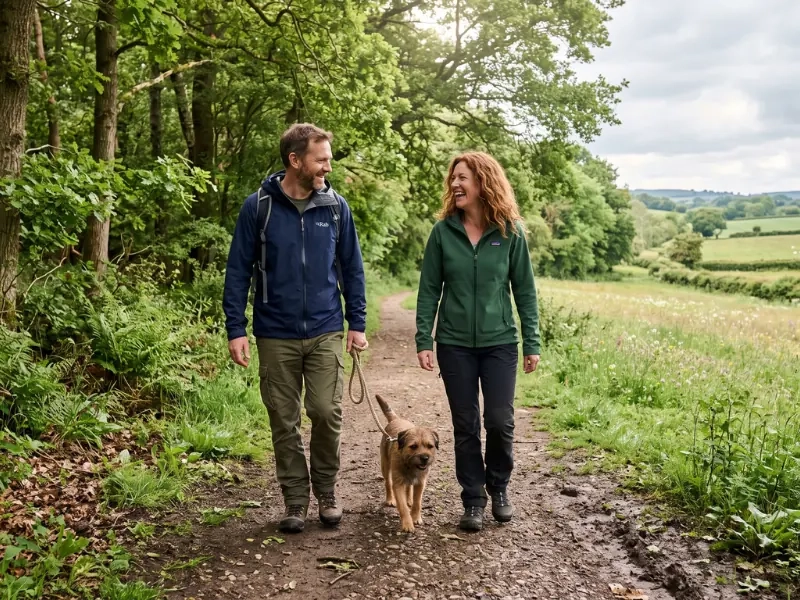
A first meeting works better as a thing you are both doing than as an interview across a table. A walk. A farmers market. A car boot. An hour at a show. You get something to look at, somewhere to point, and a natural end when the walk finishes.
Pick somewhere public, tell someone where you are going, and keep the first one short. That is not paranoia, it is just sensible, and it applies whoever you are.
We have written a longer piece on this: how to plan a first date outdoors that does not feel like a test.
6. Give it a season, not a fortnight
Rural dating runs slower. There are fewer people in range, so there are fewer messages, and a quiet week means nothing. Someone who joins in February and gives up in March has not tested anything.
Log in twice a week. Send three or four real messages rather than twenty identical ones. Judge it after three months, not three weeks. That is the honest timeline, and anyone promising faster is selling something.